
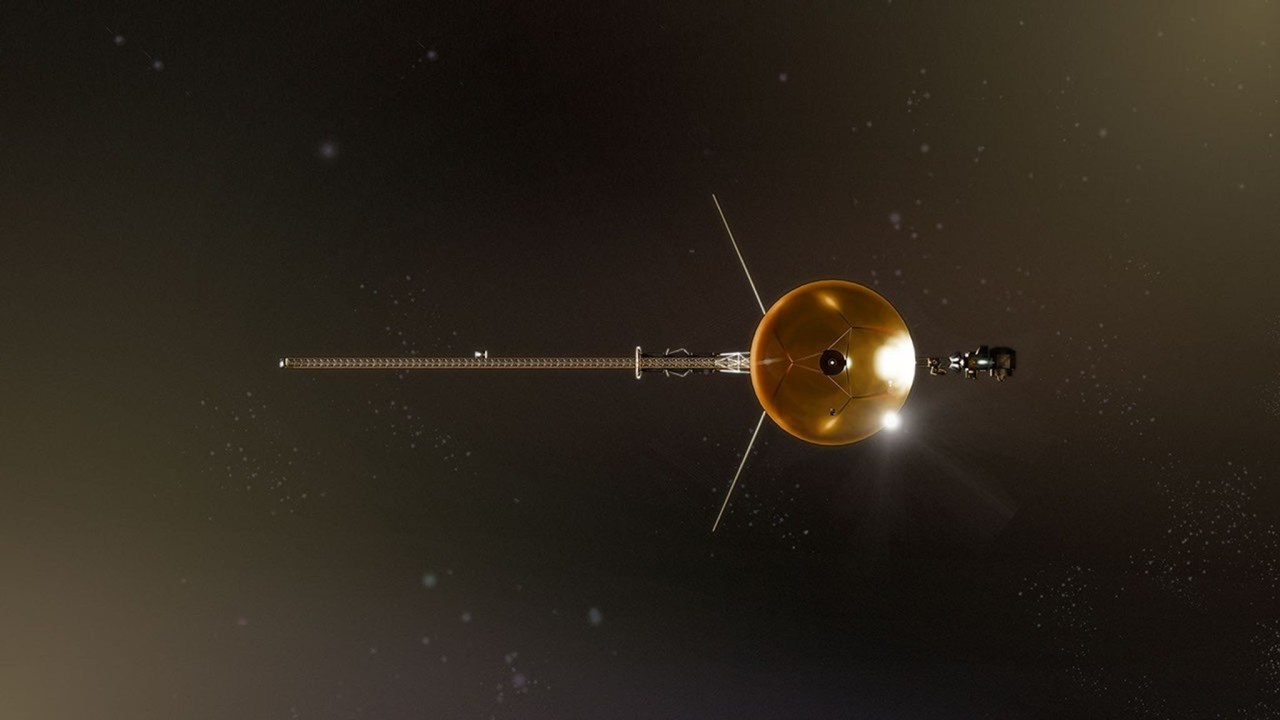
Voyager 1 Is Now One Light-Day From Home

A day can feel like a long wait for a reply. For Voyager 1, that’s now the time a message needs just to arrive. NASA’s published calculation puts the spacecraft one light-day from Earth on November 18, 2026, at about 5:16 a.m. Eastern. It’s a distance that no other object built by people has reached.
The unit describes how far light travels over 24 hours. NASA places that distance from Earth at about 16 billion miles. Voyager has spent almost half a century getting this far, while light can cross the same distance in a day.
Radio messages face that same journey. At this distance, a signal from Earth needs about 24 hours to arrive at Voyager 1, and a transmission coming back needs another 24 hours to reach us. Imagine sending a message at breakfast: it would still be traveling through the following night, arriving around breakfast the next day. Any return message would then have a day’s journey of its own.
Voyager 1 began its trip in September 1977. Its entry into interstellar space came in 2012, years before today’s distance milestone. The spacecraft that left Earth nearly five decades ago is still the other end of this long exchange.
On board is a message that left with the spacecraft: the Golden Record, a physical disc made of gold-plated copper. Its recordings include spoken greetings and music, along with sounds of Earth, chosen to represent the world that sent it. Those familiar things give this enormous distance a human scale, too.
Waiting for a message can make distance feel like absence. Voyager carries evidence of what people wanted to share across it. We sent a spacecraft out into space, and made room for the sound of home.