

The Last Meeting Theory: Every Connection Has a Final Moment — Even If You Don’t Know It at the Time

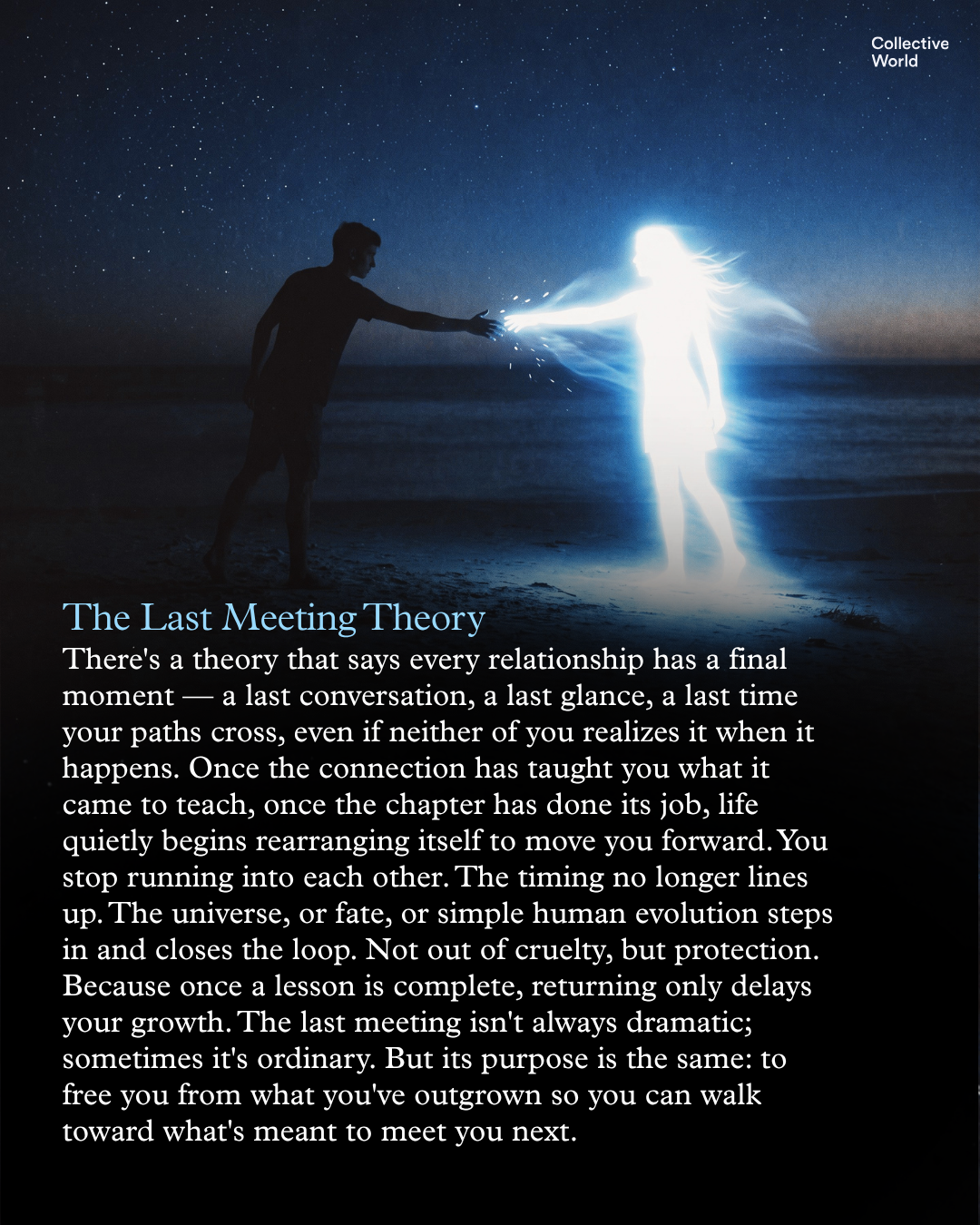
There’s a theory that says every relationship has a final moment — a last conversation, a last glance, a last time your paths cross, even if neither of you realizes it when it happens. Once the connection has taught you what it came to teach, life quietly begins rearranging itself to move you forward. You stop running into each other. The timing no longer lines up. The universe, or fate, or simple human evolution steps in and closes the loop — not out of cruelty, but protection, because once a lesson is complete, returning only delays your growth. The last meeting isn’t always dramatic; sometimes it’s entirely ordinary. But its purpose is the same: to free you from what you’ve outgrown so you can walk toward what’s meant to meet you next.
The hardest part is that you almost never recognize that moment while you’re living it. There’s no announcement, no sense of finality. You say goodbye the way you always have, assuming there will be another time. It’s only later — weeks, months, sometimes years, that you look back and realize a door had closed behind you.
That’s because connections are rarely accidental; they are functional. Certain people enter your life not to stay forever, but to serve as a catalyst for your evolution. They arrive to mirror the parts of yourself you’ve been ignoring, to challenge your boundaries, or to offer comfort during a specific, heavy season of transformation — each one tied to a version of you that was still learning a particular lesson.
Think of the friend who appeared exactly when you needed to learn how to set boundaries, or the partner who forced you to confront a wound you’d spent years avoiding. Think of the mentor who believed in you until you learned to believe in yourself, or the person whose leaving taught you that you could survive being left. None of these relationships were failures simply because they ended; they were complete. Some people are meant to be chapters, not the whole book — and mistaking a chapter for the entire story is often what keeps us constricted around our hurt.
When the lesson reaches its natural completion, the alignment that once brought you into the same room dissolves. Even if you still walk the same neighborhood streets, your timing subtly shifts and your schedules diverge. Your paths no longer intersect, because the purpose of the intersection has been fulfilled.
This is why forcing a reconnection so often feels hollow. You reach back toward someone who once meant everything, and the spark won’t catch, the old rhythm is lost to the past. It isn’t that either of you did anything wrong, it’s that the version of you that fit with them no longer exists, and no amount of effort can resurrect a dynamic whose season has passed.
There’s a deeper sense of comfort in this. It means the goodbyes you never got to say properly weren’t the tragedy you feared, and the people who drifted away weren’t lost so much as released — the empty space they left behind isn’t a wound to be filled, but a doorway held open for whatever comes next. Letting go stops feeling like defeat and starts feeling like trust: trust that life knows the difference between what has finished teaching you and what still lies ahead.
This phenomenon is known as The Last Meeting Theory.