

You Could Fit 1.3 Million Earths Inside the Sun, And It’s Still Just an Average Star

That number is volume, not (just) poetry. The Sun is 109 Earths across. Fill that sphere with worlds the size of ours and you would need 1.3 million of them. It is also almost the whole solar system: 99.8 percent of the mass. Every planet, moon, asteroid, and comet is the remainder.
To feel why the figure is so large, start closer to home. Scale does not arrive all at once.
Neptune holds about 58 Earths. Uranus, 63. Saturn takes 764. Jupiter, the largest world we have, takes more than 1,300 and still has room. Stack those giants against the star they orbit and they disappear. The Sun does not strain to contain them. It contains the idea of them.
And that star is ordinary. It is a mid-sized yellow sun, one of an estimated hundred billion or more in the Milky Way, a disk so wide that light needs a hundred thousand years to cross it. Around those stars, and adrift between them, are more worlds than we can usefully count. This galaxy is one among hundreds of billions.
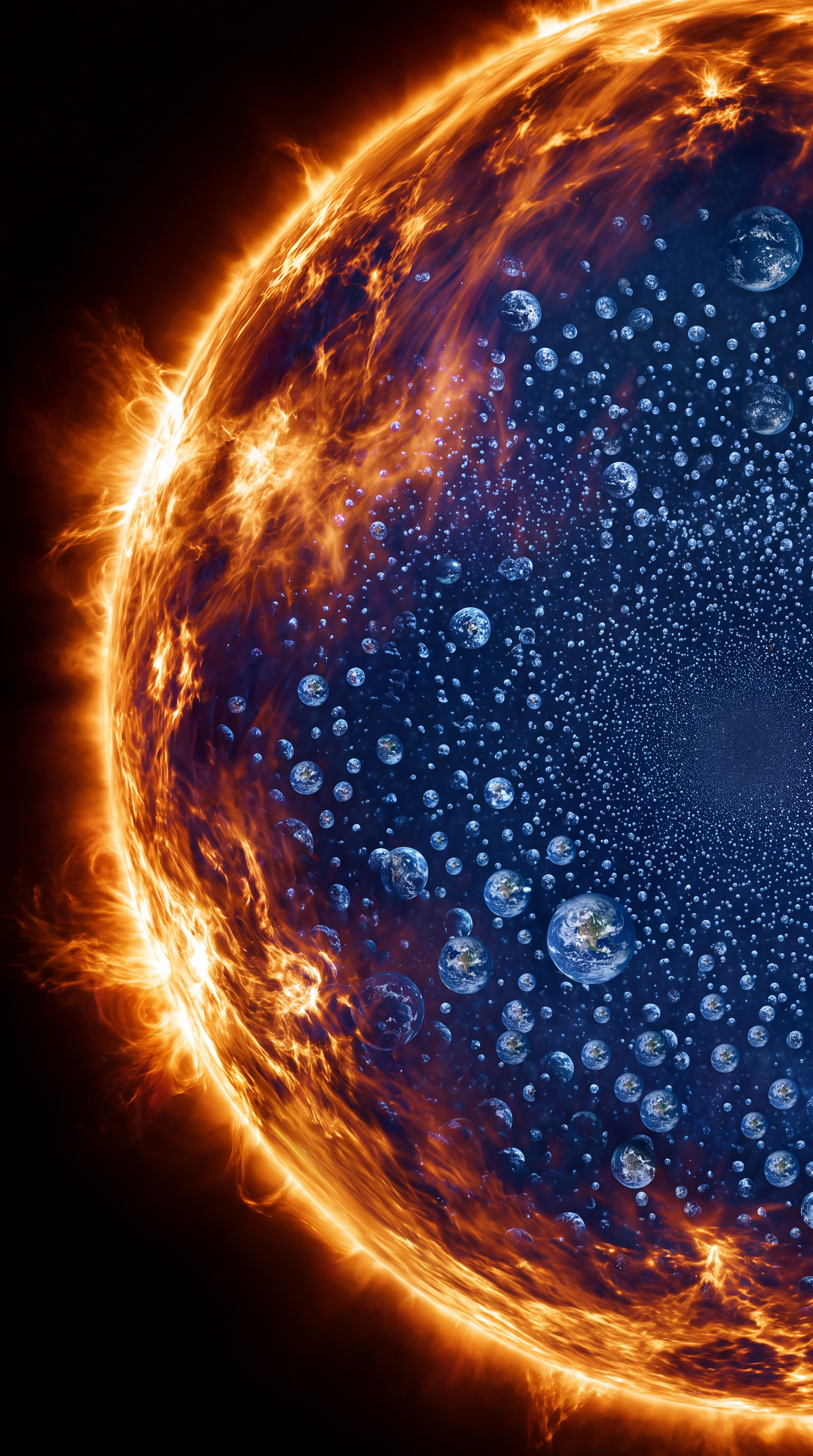
You are standing on a speck under a fire so large the mind cannot keep it. Light from that fire takes eight minutes to reach your face. You woke up inside that interval anyway, and made the day matter.
That is not smallness. That is the rarest thing there is.