
The Astrologer Who Predicted the 2020 Pandemic Called July 20th, 2026 One of the Most Important Days of the 21st Century

André Barbault spent five decades doing something most people would consider impossible: predicting specific world events, with specific dates, written down and published years in advance. He predicted the conditions for a global pandemic to emerge around 2020. He predicted the fall of the Soviet Union. He predicted the economic conditions of 2008. He was not a mystic or a vague forecaster — he was a technical French astrologer who tracked the slow-moving outer planets with the rigor of a scientist and drew conclusions that were so correct they couldn’t be easily dismissed.
Barbault died in August 2019, three months before COVID-19 was identified. He was 89 years old. He did not live to see his 2020 prediction confirmed. But before he died, he had already spent years writing about the configuration that would follow — the one he considered the more significant of the two predictions, the one he described as the turning point from the cycle of difficulty into something genuinely new. That configuration peaks today, July 20, 2026. He called it a very favorable placement for humanity. He saw it as the crescendo of everything the current era of astrology has been building toward. He did not survive to see it arrive, but he knew it was coming, and he wrote about what it would mean with the same methodical certainty he had applied to everything else.
Who André Barbault Was and Why His Predictions Matter
Barbault was not the kind of astrologer who made vague pronouncements about “big changes ahead” and waited for events to confirm them retroactively. His methodology was specific: he tracked the mathematical relationships between the five outer planets — Jupiter, Saturn, Uranus, Neptune, and Pluto, and correlated their cycles with documented historical events across centuries of recorded history. The result was a system of planetary cycles that allowed him to identify, decades in advance, when the conditions for particular kinds of collective change would be in place.
His track record is impeccable. The predictions he made were not the kind that could be confirmed by almost anything. They had specific context. In 1967, he wrote about a triple conjunction of Saturn, Uranus, and Neptune at the beginning of Capricorn in 1988-1989, and identified this as the period when a major geopolitical reorganization would occur. The Berlin Wall fell in 1989. The Soviet Union dissolved in 1991. In 2011, he wrote about the conditions for a major global infectious disease crisis emerging around 2020, connected to a specific configuration of outer planets.
The reason his prediction about July 2026 deserves to be taken seriously is not because astrology requires belief. It is because the man who made it had a documented record of being right about things he should not have been able to foresee, and because the methodology he applied to those predictions is the same methodology he applied to this one.
What Is Actually Happening in the Sky on July 20th, 2026
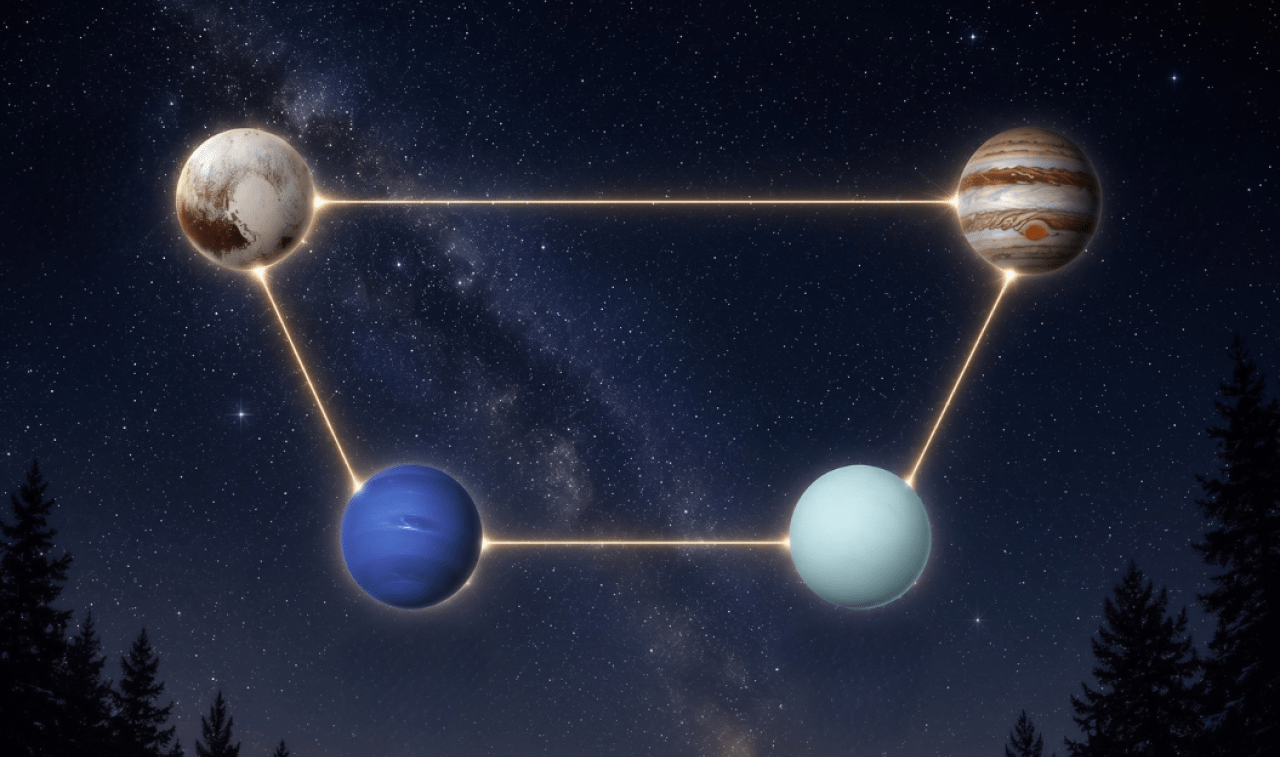
The configuration peaking on July 20, 2026, is called a Cradle — or, in the tradition of Barbault’s followers, Barbault’s Basket. It is formed by four planets occupying exactly 4 degrees of their respective signs simultaneously, arranged in a geometric pattern of supportive aspects that has no confirmed historical precedent in its precise form.
Jupiter sits at 4 degrees of Leo, directly opposite Pluto at 4 degrees of Aquarius. Neptune sits at 4 degrees of Aries, and Uranus at 4 degrees of Gemini. These four planets form the geometric shape that gives the configuration its name: Jupiter and Pluto as the spine of the basket, Neptune and Uranus as the two curved sides holding everything together. The aspects between them are not loose approximations of these degrees. They are within fractions of a degree of exact. This is a precision instrument, not a general trend.
The last time the outer planets formed an alignment of comparable rarity and harmonious geometry was in 1989, when a triple conjunction of Saturn, Uranus, and Neptune coincided with the geopolitical reorganization Barbault had predicted. That alignment was a conjunction: multiple planets stacked together, concentrated and intense. This one is a basket: planets spread across the sky in a supportive relationship with each other, holding space for something collectively expansive rather than concentrated and acute. The energy of the two configurations is as different as a closed fist and an open hand.
What Each Planet Is Doing in This Configuration
Understanding what the Cradle is actually producing requires understanding what each of its four planets governs and what their current signs add to that governance.
Jupiter at 4° Leo is the amplifier of this configuration. Jupiter expands whatever it touches, and in Leo, the sign of creative courage, full self-expression, and the heart’s most authentic offerings — it is expanding the collective capacity for boldness, generosity, and the willingness to lead from passion rather than from fear or obligation. Jupiter in Leo at the handle of this basket is essentially asking what happens when abundance meets full self-expression. The answer this configuration is producing is: more of what is genuinely good, at a scale that has not been available in recent memory.
Pluto at 4° Aquarius, directly opposite Jupiter, is the depth charge of the configuration. Pluto in Aquarius has been doing the slow, thorough work of dismantling the structures that have controlled information, concentrated power in the wrong places, and made the question of who gets to be seen and heard a function of who controls the platform rather than who has something worth saying. Pluto opposite Jupiter in this basket is the specific tension that drives the configuration toward something genuinely new rather than simply more of what already exists — the force that ensures the expansion Jupiter is producing is expansion that serves the collective rather than the few.
Neptune at 4° Aries is the spiritual current running through everything else. Neptune governs the dissolution of boundaries — between self and other, between what is and what could be, between the old story and the new one. In Aries, the sign most associated with identity and new beginnings, Neptune has been dissolving the rigid definitions of who we are allowed to be and replacing them with something more fluid, more open to possibility, more willing to ask the question of who we actually are rather than who we have been told to be. In this basket, Neptune is the intuition; the knowing that what is being activated today is not just astrologically significant but spiritually so.
Uranus at 4° Gemini is the live wire. Uranus governs unexpected breakthroughs, sudden reversals of what seemed fixed, and the specific kind of change that arrives before anyone was ready for it but that, in retrospect, was always the obvious next thing. In Gemini, which governs communication, information, and the way ideas move between people, Uranus is already rewiring how thought travels through the world, accelerating the pace at which new information becomes possible, disrupting the systems that have controlled what is allowed to be known. In the basket, Uranus is the unexpected solution. The idea that arrives from nowhere and makes everything else transform around it.
What Barbault Said About What This Means
Barbault was not fond of optimistic generalizations. His conclusions were typically measured, technically grounded, and careful in proportion to the evidence.
He described this moment in history as a reorganization of power and a change in the distribution of resources. He predicted that people would be more anti-war and more willing to help each other. He saw the period beginning with this configuration as the opening of what he called a Golden Era — not in the naive, utopian sense, but in the specific sense of a period in which societies become more humanistic, in which the questions that have been suppressed or avoided at the collective level finally get asked directly. The questions he anticipated: What are institutions actually for? Who controls information? What is money for? Who do governments serve?
These are not small questions. They are the foundational questions of how collective human life is organized, and they have not been asked with genuine collective force since the last major reorganization of the kind Barbault’s basket predicts. He saw 2020 as the cyclical low, the pandemic as the nadir of the difficult cycle; and he saw the 2026 configuration as the ascending counterpart to it. The most significant astrological event of the 21st century not because it would bring destruction, but because it would bring the turning point.
He called what is happening today the crescendo.
Why This Feels the Way It Does Right Now
Most people experiencing this day will not feel a chaotic shift in the way they feel at the site of an earthquake or a major life event. The outer planets operate slowly, and the configurations they form produce changes in the underlying conditions of collective life rather than in the immediate texture of a single day. What is being activated on July 20th is a restructuring of the long-cycle conditions that determine the general character of the years ahead — not a single day’s experience, but the first movement of something that will unfold over years and decades.
What you may be feeling is a sense of something having shifted that is difficult to name. A quality of life that is different from what it was a week ago. The sense that certain questions that have been circling without landing are approaching a point of resolution. The feeling, arriving without obvious cause, that something has turned.
These are not illusions. The configuration peaking today has been building for months — Jupiter’s ingress into Leo on June 30th began the activation, and the basket has been forming and tightening throughout July, drawing the four planets into their precise geometric relationship with the kind of mathematical inevitability that is Barbault’s whole argument about how the sky works. What peaks today has been in formation since the year began, and what it initiates will continue to unfold long after today has passed.
What Comes Immediately After
The days immediately following the peak of the Cradle are not gentle. Mercury stations direct on July 23rd — the retrograde that has been drawing the past back into the present throughout Cancer season completing its cycle and releasing forward momentum. Saturn turns retrograde on July 26th, beginning an interior review of what has been built during the structural work of the past year. And on July 27th, the Lunar Nodes move into Aquarius and Leo, inaugurating the eclipse season that will define the final months of 2026.
The Cradle does not simply peak and vanish. Jupiter will move beyond its precise 4-degree alignment within weeks, but Pluto, Neptune, and Uranus will continue their triangular formation — the supportive aspects between them maintaining their influence into 2028. What the basket activates on July 20th is not a single day’s opening but the beginning of a two-year wave of the conditions Barbault described. The crescendo lands today. The music continues.
What to Do With Today
Barbault’s prediction was collective in scope: about the reorganization of power, the redistribution of resources, the opening of a more humanistic era. What that produces at the personal level is less obvious and more individual, shaped by where the 4-degree activation falls in your own chart and what the particular mix of Jupiter, Pluto, Neptune, and Uranus stirs in the specific territory of your life.
What is available to everyone today, regardless of chart placement, is the specific quality of energy that a Cradle configuration produces: the sense that what you are building, choosing, and orienting toward right now is being held by something larger than the immediate circumstances. The Jupiter-Pluto opposition at the spine of the basket is the reminder that genuine change requires genuine confrontation with what has been consolidated in the wrong hands. But supported. The harmonious geometry of the basket is not passive. It is a structure that holds what is placed inside it and allows it to grow.
Pay attention to what becomes clear today that has not been clear before. To the question that finally gets asked that has been circling for years. To the direction your life seems to be pulling toward with an unusual quality of certainty. The seeds planted inside a Cradle configuration have a growing season measured in years, not weeks. What you put into motion today — the intention named, the direction chosen, the commitment made, is going into unusually fertile ground.
The man who predicted the pandemic, the fall of the Soviet Union, and a dozen other moments the rest of the world was not ready for died knowing this day was coming. He called it the most favorable placement for humanity he had seen in his lifetime of tracking the sky. That prediction is arriving now, in the specific and mathematically precise form he described, in the year he identified, at the degrees he calculated.
He was right about the hard things. The reasonable assumption is that he was right about this one too.